
Where to Go Birdwatching in Mongolia: Species, Seasons & Best Spots
Mongolia sits along major migratory bird routes, drawing rare cranes, eagles, and lake birds each spring. Here’s what to look for and where.
Every spring, Mongolia quietly becomes one of the more important stops on the map for migratory birds. Long before most travelers think to look here, rare cranes, eagles, and lake birds are already arriving by the thousands, drawn to the country’s undeveloped wetlands, open steppe, and river valleys. It’s one of those things people rarely associate with Mongolia until they see it for themselves.
Part of what makes this possible is how much of the country remains untouched. Mongolia has some of the lowest population densities on earth, and huge stretches of it have never been developed or disturbed. For migratory birds looking for safe places to rest, feed, and breed along their route, that kind of undisturbed land is increasingly rare, and increasingly valuable.
Table of Contents
Why Mongolia Matters for Migratory Birds
Understanding how things work in Mongolia can be confusing. Here are some things I’d book for my first trip to the country.
🚕 Airport Transfer into Ulaanbaatar
Book your airport transfer before you land. Ulaanbaatar taxis are chaotic and this is worth the peace of mind.
🛌 Where to Stay
My picks at every budget, all within walking distance of the main square:
→ Hostel One: best hostel in the city for solo travelers
→ Urgoo Hotel: locally owned boutique spot, great value and location
→ H9 Hotel Nine: steps from Sukhbaatar Square, ideal for first-time visitors
→ Best Western Premier Tuushin: 4-star hotel next to Sukhbaatar Square, super comfortable

👉 Make the Most of Your Time in Ulaanbaatar
If you have extra days, these are the day tours and 1-day experiences that start and end in Ulaanbaatar I’d actually recommend:
→ Ulaanbaatar: Private Guided City Tour with Car
→ Cooking Class in a Local Home
→ Mongolian Traditional Dance & Music Concert Ticket
→ Chinggis Khaan Equestrian Statue & Terelj National Park
→ Ulaanbaatar: Private Nomad Horseback Ride + Homemade Lunch
Why Mongolia Matters for Migratory Birds
Mongolia sits along major flyways connecting breeding grounds in Siberia and Central Asia to wintering grounds further south. Its lakes and wetlands act as essential rest stops for birds covering enormous distances, while its open steppe and mountains offer breeding habitat that’s become scarce elsewhere.
This isn’t a minor stopover for a handful of species either. Some of the birds that pass through or breed here are genuinely rare on a global scale, and Mongolia’s lakes are considered internationally important habitat for several of them.
Birds You Might Spot
Below are some of the spectacular species you might spot along your birdwatching journey through Mongolia.
White-naped Crane
One of the rarer crane species in the world, the White-naped Crane returns each spring to breed in Mongolia’s quiet wetlands and lake edges. Tall, elegant, and marked with striking black and white plumage, they’re calm, deliberate birds, and Mongolia is one of their key breeding grounds globally.
Demoiselle Crane
Smaller and more delicate than the White-naped Crane, Demoiselle Cranes nest across Mongolia’s open steppe in spring and summer. They’re known for one of the most demanding migrations of any bird, crossing the Himalayas twice a year to reach their wintering grounds.
Golden Eagle
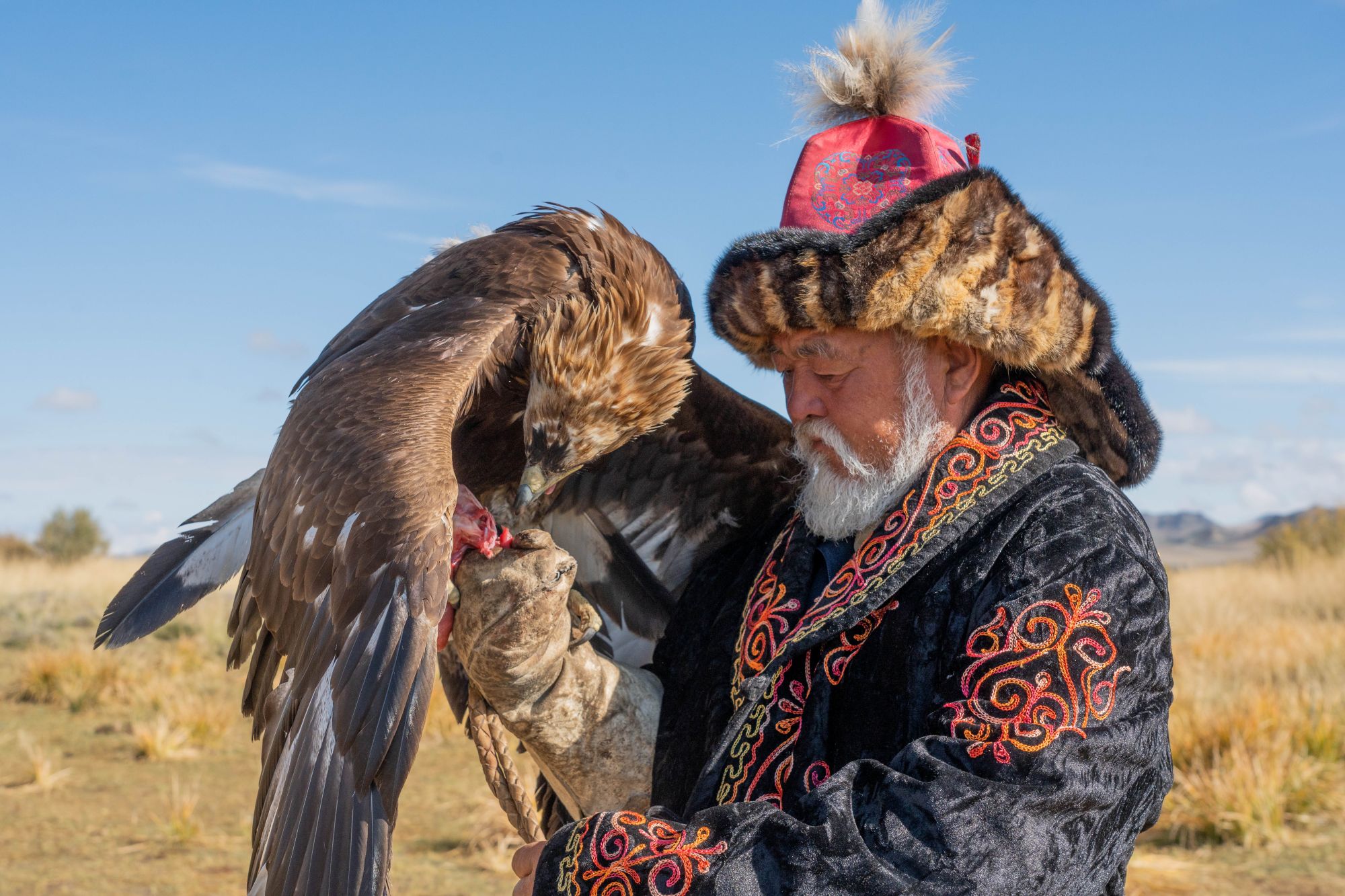
The Golden Eagle is one of Mongolia’s most iconic birds of prey, and one of the few species you can find here year round. Large, powerful, and remarkably intelligent, they’re often seen riding thermals above mountains and open steppe, and hold deep cultural significance in Mongolia beyond just birdwatching.
Steppe Eagle
True to its name, the Steppe Eagle is a bird of the open plains. It migrates long distances to breed in Mongolia each spring and is often spotted gliding low over grasslands, scanning for prey. It’s a defining species of the broader Eurasian steppe ecosystem.
White-tailed Eagle
Usually found near lakes and rivers, the White-tailed Eagle is one of the largest eagles in the region, with a broad wingspan and pale tail that make it easy to identify. They’re most often seen perched near water or flying low in search of fish.
Falcons
Several falcon species move through or live in Mongolia, including the Saker Falcon and Peregrine Falcon. Fast, agile, and usually spotted perched on rocky outcrops or darting through open sky, Mongolia plays a genuinely important role in falcon conservation globally.

Swans and Lake Birds
Large migratory swans arrive at Mongolia’s lakes each spring, particularly at places like Ugii Lake, often traveling in pairs or small groups. Alongside them, the lakes fill with ducks, geese, and other wetland species resting and refueling before continuing north.
Where to Look
Mongolia’s best birdwatching spots tend to cluster around its major lakes and river systems. Ugii Lake, in central Mongolia, is known for both migratory cranes and swans and has a small bird protection center nearby. The Orkhon River and surrounding valley are another key corridor, both ecologically and historically, running near Kharkhorin, the ancient capital of the Mongol Empire.
Further out onto the steppe, national parks like Hustai add another layer to the experience, not just for birds but for the wider wildlife that shares the same open grassland, including Przewalski’s horses, marmots, and argali sheep.
The Best Time to Go
Birdwatching in Mongolia is best between May and September, when migratory species have returned to breed and the country’s lakes and wetlands are at their most active. Spring tends to bring the widest variety of species, as birds arrive in waves along the flyway, while summer offers a chance to see breeding behavior up close.
Sightings are never guaranteed with any wildlife, and birds are no exception. But the sheer scale of migration passing through Mongolia each year means that patient, quiet observation, especially near water at sunrise or sunset, tends to pay off.
Author: Breanna Wilson
Hi! Sain uu! I’m Breanna, an American travel writer and adventurer living in Ulaanbaatar, Mongolia for more than 9 years. I’ve written for and been featured in Condé Nast Traveler, CNN, Forbes, and the New York Times, among others. Read more of my Mongolia travel articles here.


Join our Private MIM Community on Facebook
Proudly Based in Ulaanbaatar, Mongolia
© 2026 Meanwhile in Mongolia